
 Chat with AGB Board Bot
Opinions expressed in AGB blogs are those of the authors and not necessarily those of the institutions that employ them or of AGB.
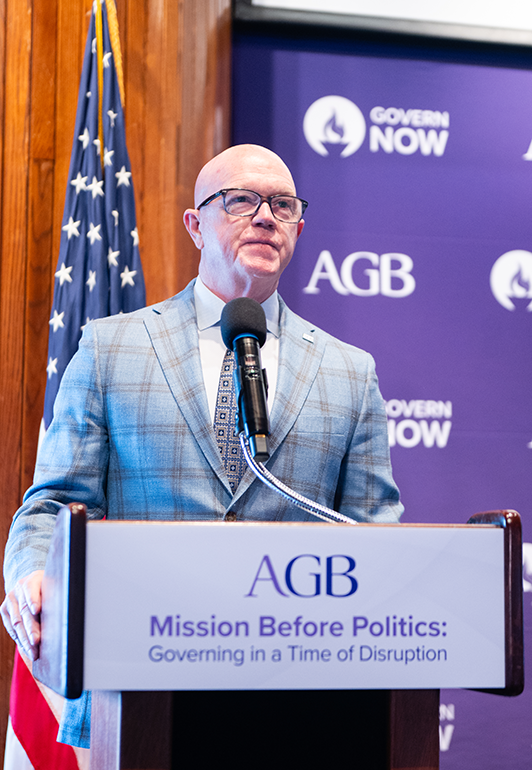
AGB President and CEO Ross Mugler welcomes attendees.
Credit: AGB
Members of college and university governing boards across the country today are keenly aware that the current loss of public trust, growing restrictions on free speech and academic freedom, and undue political influences are creating pressures on higher education’s leaders that have rarely been seen in the nation’s history. To help draw attention to the seriousness of these issues, AGB recently hosted an event at the National Press Club in Washington, D.C., with the theme Mission Before Politics: Governing in a Time of Disruption, to share strategies and key questions that boards should be asking themselves at this moment.
In his opening remarks, AGB President and CEO Ross Mugler outlined the purpose of the event to “illuminate what happens when governance becomes less about mission and more about individual agendas and understand what it takes to build and sustain boards capable of independent, mission-driven leadership.”
The event featured two expert panels, both facilitated by Doug Lederman, former editor and co-founder of Inside Higher Education.
The first panel addressed the current challenges from the perspective of public institutions and systems. Geoff Landward, commissioner of higher education for the Utah System of Higher Education, Candi Mundon King, secretary of the commonwealth of Virginia, and Major General Cedric T. Wins, former superintendent of the Virginia Military Institute, shared their strategies for building a board culture committed to fiduciary duty and shared governance. They also discussed their concerns surrounding higher education today, particularly on the dangers of partisan influence on board members.
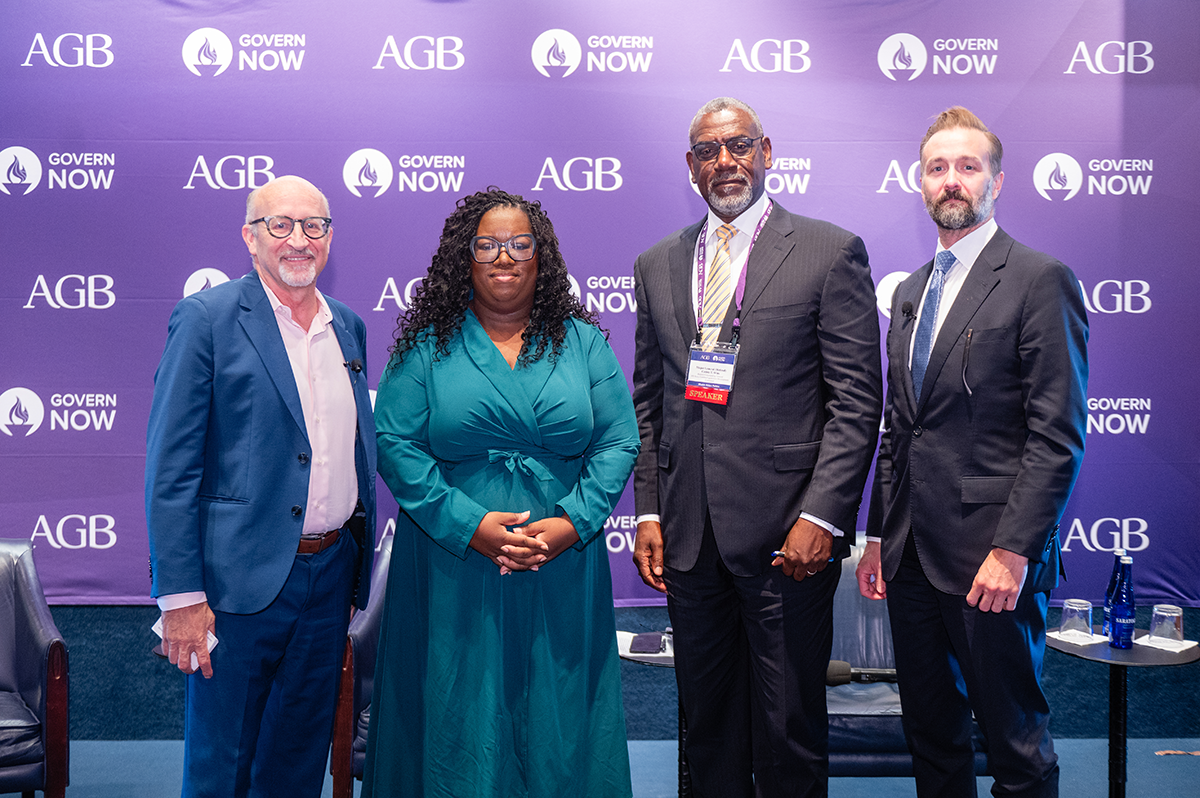
Pictured from left to right, Doug Lederman, Candi Mundon King, Major General (Retired) Cedric T. Wins, and Geoff Landward.
Credit: AGB
The second panel focused on First Amendment issues in higher education. Ona Alston Dosunmu, president and CEO of the National Association of College and University Attorneys, Kristen Shahverdian, director of higher education and free expression programs at PEN America, and Michael Schill, president emeritus of Northwestern University and former president of the University of Oregon, discussed the importance of strong board chair-president relationships, long-term institutional health, and the importance of preserving academic freedom and freedom speech in higher education.
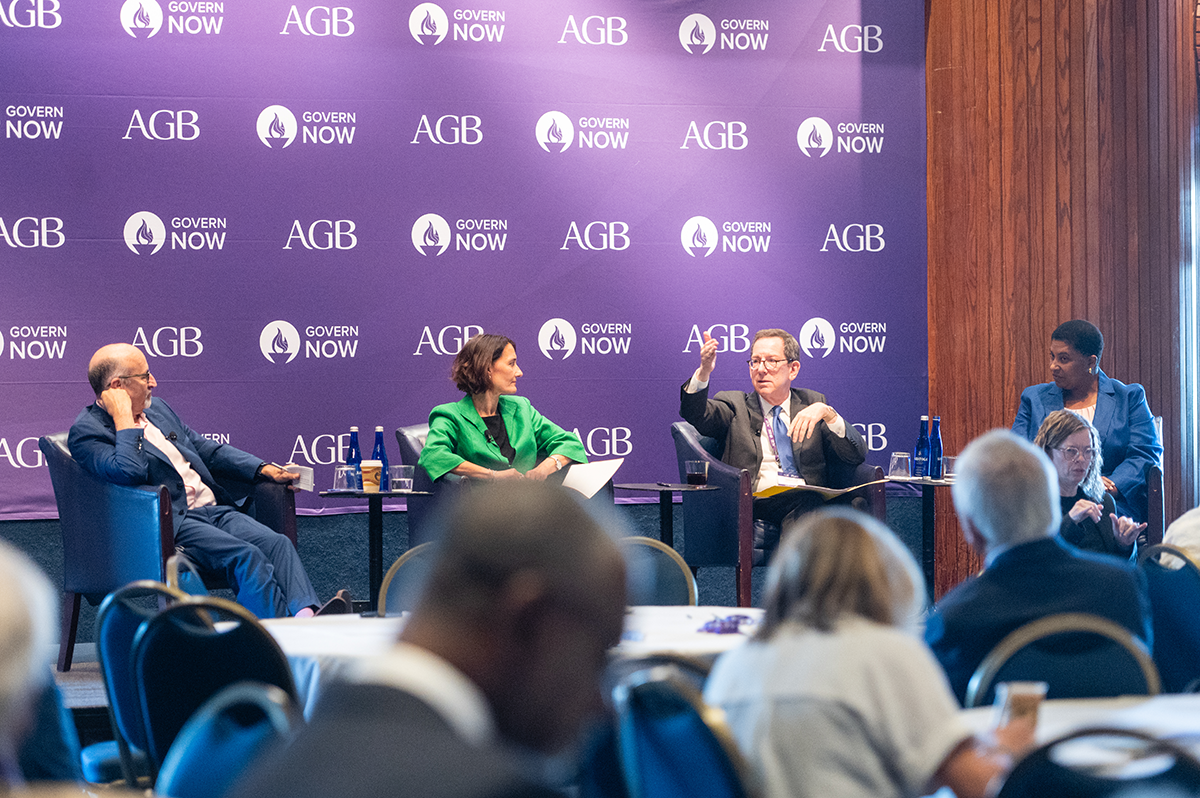
Pictured from left to right, Doug Lederman, Kristen Shahverdian, Michael Schill, and Ona Alston Dosunmu during their panel.
Credit: AGB
Committing to the Ideals of Higher Education
Speakers warned that when governing boards don’t understand higher education’s mission, particularly the principles of academic freedom and free speech, it often leads to conflict among board members. At times, this division may be along partisan lines. Fortunately, good governance based on dialogue and connection can help bridge the divide. The panelists offered practical strategies for higher education board members to use in upholding the principles of good trusteeship, both collectively and individually.
Several panelists stated that board culture and composition matter more than size or structure for countering the extreme influences that many boards now face. Positive relationships among board members can drive success and can help boards handle crises more effectively. Looking beyond the party affiliation of board members to find common interests can be a good starting point, speakers suggested.
They also emphasized the importance of board members reinforcing the board’s commitment to the institution’s mission. Governing boards should maintain the core principles of the institution, regardless of the circumstances, they advised. The mission, vision, values, and financial sustainability of the institution should be at the center of each trustee’s decision-making.
New board members should understand the fundamentals of higher education board governance, including shared governance and the scope of authority of the board, panelists noted. Besides fostering diverse skill sets and filling gaps in board knowledge when boards have input in new trustee selection, speakers advised looking for members willing to learn what it means to be a good board member and trying to choose candidates committed to the tenets of higher education. Finding board members with the skills to create strong working relationships with other board members, with stakeholders such as the president, and with the community writ large, will be a boon to an institution in the long run, they added.
For the sake of continued experience and leadership, particularly on public boards where there may be a higher level of turnover caused by political appointments and state elections, speakers advised board leaders to have a plan in place to ensure the continuation of knowledge. Boards need increased education regarding academic freedom and free speech, which are at the core of higher education’s purpose. Continuous board education in these areas can also help to reinforce the role of the board, minimize confusion and conflict, and help boards be better prepared for crises that might arise, they indicated.
Strategic Advocacy
Panelists acknowledged that higher education is facing growing public criticism. According to Landward, voters sometimes wonder, “Why do we keep funding a system of higher education whose values don’t align with the values of the voters funding it?”
Board members are uniquely positioned to communicate the value of their institutions and advocate for policies that strengthen independent governance, panelists asserted. Trustees should understand and communicate why colleges and universities are important and worth preserving, including their value as being incubators for social mobility, increased economic opportunities, innovative research, and teaching students how to think. As Mundon King emphasized, higher education isn’t just about educating students, it also lifts the community and supports the economy.
Renewing Higher Education’s Purpose
Panelists suggested that when boards codify good governance practices, they help ensure their institutions’ longevity. If boards understand what free speech and academic freedom are and aren’t, they will be better equipped to advocate for their institutions. They will also be better able to defend their institutional autonomy, which is derived from these core freedoms. AGB’s President and CEO Ross Mugler summarized the importance of properly functioning governing boards this way: “Good governance powers colleges and universities and enables them to innovate, serve their mission, educate their students, and contribute to their communities.”
Justine Ballard is the assistant editor of Trusteeship at AGB.
RELATED RESOURCES

Trusteeship Magazine Article
Why Does Free Speech Matter on Campus?

Reports and Statements
How to Govern for Institutional Autonomy


Reports and Statements
Top Public Policy Issues Facing Governing Boards in 2025–2026